
In the past couple of years, I have slowly sold off my Canon gear and replaced it with a Sony mirrorless system. I mainly shoot weddings and portraits as a profession, and my current go-to camera for this type of work is the Sony a7II, for which I will put together a proper review in due time. But, my first foray into mirrorless was the Sony RX1. After a couple of years of owning the camera, I still carry it along with me to my photo gigs as a secondary camera. It is also permanently at arms reach when I am at home to document my daily life. Now, camera reviews are usually done within a few weeks of a new camera launch, but I thought it would be fun to review the RX1 now that I’ve had over two years to get familiar with it. I’ll explain what I love about it and what I think is lacking, complete with sample images that I’ve created with it.
Introduction

It was hard to find a superlative when I realized that the Sony RX1 has been in production for over two years now, and the list price has not changed from its original $2700 price tag! It’s perfectly acceptable, I think, to be either dumbfounded or amazed, or some combination of both. The RX1 though, was a revolutionary camera at its introduction and has only proven to be more so two years later. Since, this is a retrospective review, most people already know the camera’s specifications, so I won’t go through that laundry list. What I’d like to do instead is highlight the features that continue to make an impression on me and that still makes the camera relevant today.
24 Megapixel Full-Frame Sensor
 Monterey, California, Sony DSC-RX1, f/8.0, 1/1000 sec., ISO 160
A sensor in the 24 megapixel range is pretty standard nowadays. It’s a nice resolution, perfect for a large wall print when you capture that right moment. With what I do for work, it is also perfect since I use a couple of Sony a7II cameras (which also uses a 24 MP full-frame sensor) in tandem with the RX1. All the files in my Lightroom catalog are really good friends and get along well, they all match. But, for me, the biggest deal regarding the sensor (and it still is to this day) is that it’s full-frame. I still don’t understand how they crammed that into such a petite, little camera. Even today, I know of no other manufacturer that has released a full-frame sensor in such a small package. Now, there are murmurs that I already hear behind the matrix of the internet saying full-frame sensors are not that big of a deal, megapixel count is more important; that you can get the same quality on a smaller sensor if it’s at a higher resolution. But, you know, I just never understood that line of thinking, because there has always been a certain look that is attributed to medium format cameras, just as there is a certain look to full-frame 35mm cameras, and vice versa with cropped sensor cameras. Bigger sized sensors (not megapixels) have more depth of field; the bokeh (or out-of-focused part of the image) have different renditions between the various sized sensors. Don’t worry, I’m not going on an extended nerd-rant here for too long, but I’ll just show you what I mean. I took an APS-C camera, the Canon Rebel T2i for this example, with a 35mm lens set at f/2 and took a photo of this lovely succulent plant, then I took the same exact shot with a full-frame camera (the Sony a7II) using a 55mm lens this time to get the closest equivalent focal length as the APS-C field of view (35mm x 1.6 crop-factor = 56mm). As I took the two comparison photos, I composed them in a certain way so that the framing between the two different cameras would match.

Can you see a difference in the way the backgrounds are rendered between the two different sensors? The larger, full-frame sensor blurs out the background more at the equivalent focal length of the smaller sensor. All this to say, “Hey, a full-frame sensor in a small compact camera is a purdy big deal, ya’ agree?” Not only is the RX1’s sensor full-frame, but it’s a really good one at that. Highlight and shadow details are maintained better than on my previous workhorse camera, a Canon 5D Mark II, and the noise levels are acceptable for documentary work up to ISO 6400, at least to my eyes.
Fixed 35mm f/2 Zeiss Lens

Most people nowadays are used to an interchangeable lens system. I mean, if you want to shoot landscapes, put a wide angle lens on that thing; if you want to do portraits, stick an 85mm on it; and if you want to get some action shots of your kid’s soccer game, put that long zoom on there. One camera, multiple lenses. It’s so versatile. So, when the RX1 came out with a fixed 35mm lens and asked you to pay almost three grand, it was understandable that people thought it was a typo. Nowadays, you can get a Sony a7 camera body with two or even three lenses, and a camera bag for under three grand. Personally though, after using it for a couple of years, I find the 35mm focal length to be perfect middle ground for anything you’d want to use the RX1 for anyway.
 Paletas for the children, Sony DSC-RX1, f/5.0, 1/500 sec., ISO 100
 Two fries at a time, Sony DSC-RX1, f/4.0, 1/200 sec., ISO 200
 Tres, Sony DSC-RX1, f/2.0, 1/80 sec., ISO 5000
 Under the open sea, Sony DSC-RX1, f/2.0, 1/80 sec., ISO 1250
 Best buds, Sony DSC-RX1, f/4.0, 1/500 sec., ISO 640
This camera was designed for everyday life, wherever it may take you. It’s a great focal length for documenting moments at home, capturing people in environments when you’re walking around outdoors, and when you get close up, you can get some really nice portraits — it’s just at the right spot before it’s too wide for head & shoulder length people pictures.
 Senior portrait, Sony DSC-RX1, f/2.0, 1/320 sec., ISO 100
The folks at Sony had a problem to address, they wanted as fast an aperture as they can get, while keeping the lens as small as they can possibly can. And if you take into account that the camera has a full-frame sensor (which means the lens design usually has to be bigger than their cropped-sensor counterparts), it is easy to assume that this lens could have actually been bigger than what it is currently, so I’m pretty happy that they got it as small as they did.
 Engagement portrait, Sony DSC-RX1, f/2.0, 1/1250 sec., ISO 50
Apart from the RX1 being my first mirrorless camera, this was also my first experience with a Zeiss lens. Before this, all I knew was Canon optics. Needless to say, this lens turned me into a big Zeiss fan. The colors are vivid and true-to-life, it produces images that are sharp from edge to edge, the bokeh is beautiful, and the build quality is top notch. Falling in love with this lens made it easy for me to get another Zeiss lens. I am now also a happy owner of a Sony-Zeiss 55mm f/1.8 for my a7II, which I also love to use.
There are a couple more things to mention about this lens. One thing that people usually don’t think about is how consistent that quality is across the entire field of view of the lens. This 35mm Zeiss is beautifully consistent across the frame, no soft corners or crazy color shifts when you get to the edges. The other thing is the dedicated aperture ring. This feature is like comfort food. It just feels so good to use, that you just want to keep using it. And when it’s gone, you miss it. That’s how I felt after using the aperture ring on the RX1 for an extended period of time, then returning to my Canon gear. You hear the clicks as you turn the ring, and you can tell without looking that three clicks to the right means you just switched from f/2.0 to f/2.8. It also makes it fun and convenient when you’re shooting in Aperture Priority or Manual mode, since my left hand is usually free directly under the camera, I can quickly change the aperture without removing my right trigger finger from the shutter release button. I’ve grown accustomed to shooting this way and all I have to say is that I love it. I wish all lenses had this feature (but I have to admit, a dedicated aperture ring is more useful to me on a wide angle lens like a 24 or 35mm, because I tend to change apertures more on the wider end than when I am do on an 50mm or longer focal length).
 Los Angeles, Sony DSC-RX1, f/2.0, 1/100 sec., ISO 2500
 Yellow flowers, Sony DSC-RX1, f/2.8, 1/1000 sec., ISO 100
Lastly, I want to mention about the lens is it also has a macro-mode switch that allows you to adjust the focusing distance of the lens, letting you focus a little closer to get macro-like shots. It’s not a true macro lens, but it’s pretty handy for getting a little closer and get into the details.
High-Resolution LCD Screen
Being used to big, heavy duty DSLR cameras, it was quite a departure for me to use the RX1. When you pick it up, it’s evident that the camera is designed to be used one-handed. That’s why I call it my ‘fun camera’. There’s really no effort needed when using it. It’s just as small as a smartphone (although it’s way thicker). You can definitely drop it into a big jacket pocket if you’re on the go and don’t feel like bringing a bag — that’s something I would never even consider with my 35mm f/1.4 hooked up to a Canon 5D. So, it was obvious that Sony had to lay out the buttons and dials to accommodate one handed shooting. Add to the equation that there is no viewfinder on the camera. All the composing duties are relegated to the high-resolution LCD screen on the back of the camera, just like on a standard point-and-shoot or an iPhone. A built-in electronic viewfinder might have been nice, but definitely not a deal breaker. Even without the EVF, you still get the what-you-see-is-what-you-get viewpoint that has been the trump card of the mirrorless experience. Ever since I first learned how to use a DSLR, I’ve always wondered if camera companies could evolve their cameras so that you can see everything in the viewfinder as the sensor would capture it. In other words, a live view mode. This way, you can see all the effects on the image instantly as you change your settings. I thought photography new-comers would learn so much faster if this was the case, and veterans would save a lot of time from chimping less (or looking less at their photos from the LCD screen after they’ve taken it). This of course, has been done within the last few years on DSLRs, but it hasn’t been a feasible mode to use with regularity or for an extended period of time. The focusing is horrendous while in live-view and it ate up a lot of the battery. If you break it down though, mirrorless cameras are essentially live-view cameras. This has always been the case with compact point-and-shoots and, of course smartphones, but like I mentioned, focusing supremacy was reserved for the DLSR category. Fast forward to the present, and you will see that the landscape is quickly changing. Mirrorless cameras are getting faster at focusing. Just take a look at the Sony a6000, and the upcoming a7RII. I think the final hurdles of mirrorless cameras are battery life and EVF clarity/responsiveness. We already see these issues being seriously addressed by Sony and other companies, which makes these next couple of years an exciting time to move into mirrorless.

With the RX1, there is an option of adding an EVF (electronic viewfinder) peripheral that attaches on the hot-shoe mount, but it does make the camera considerably bigger, and it costs $400. Personally, I’d like to try the RX1 with an EVF, but I have never felt it to be necessary, the LCD screen is good enough for what I need.
User-Assigned Custom Buttons
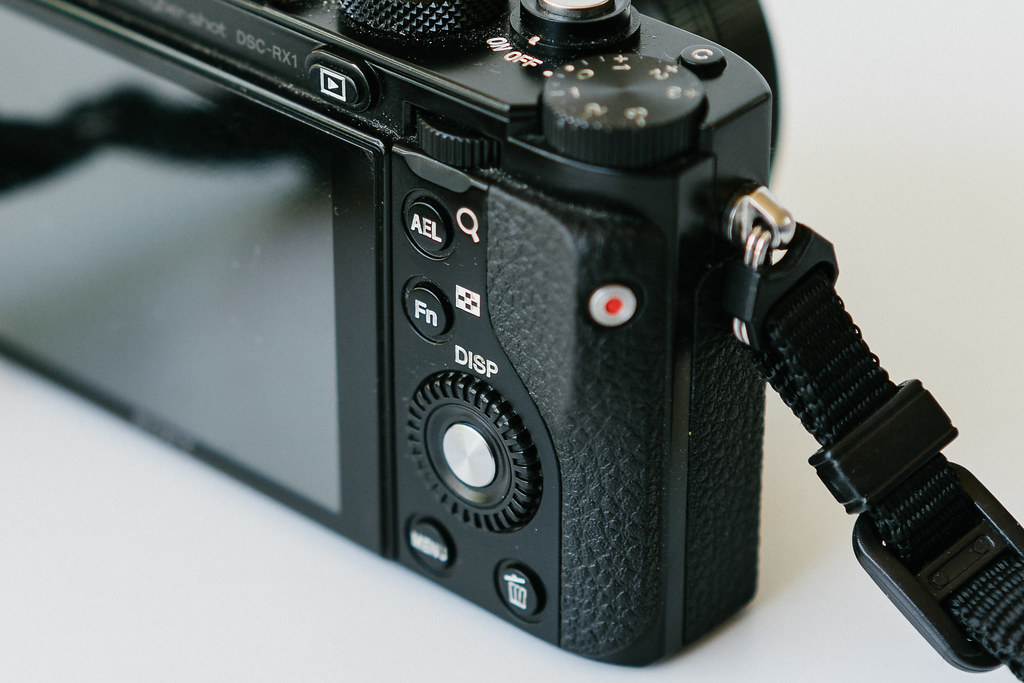
Sony used a simple-is-better approach when designing the user interface on the RX1. There are essentially four functional buttons on the back, a jog-wheel that serves double-duty as another set of four buttons (up, down, left, right, and center) and a “C” or “custom” button on the top, next to the shutter release. One cool thing about many modern cameras is the ability to customize the function for most of the buttons. Everyone is going to have different functions dedicated to each button, but here is how I’ve set the customizable buttons on my RX1:
• “C” BUTTON: Exposure lock toggle
• AEL: Manual focus hold
• LEFT: Drive mode
• RIGHT: ISO
• DOWN: White balance
• CENTER: Focus area selection or Focus tracking
I usually shoot in either Aperture Priority mode or Manual, the ISO is set to AUTO, and the focus mode is on AF-S (single), using either the center focus area or a custom selected area. With this setup, I am able to shoot single-handed with ease in most situations. In addition to the custom buttons, the RX1 has a dedicated aperture ring, an exposure compensation dial, a physical knob on the front for switching between autofocus and manual focus modes, a scroll wheel for adjusting shutter speed, and a dedicated (yet awkwardly placed) movie record button in case you want to record a video. With this current set up, I have all the functions that I use frequently within one or two button presses, and no time wasted on sorting through a menu system. The menu system by the way, is not laid out well, so I am glad that I don’t have to venture there often. I do wish that the delete/trash button was configurable as well, like on the a6000 and the a7 series bodies, because another custom button could have been very useful.
Silent Leaf Shutter
When I first used a DSLR, the chunky sound of the mirror movement and shutter release was like music to my ears. It’s that gratifying tactile response that you receive after I capture an image. It made me feel like a real photographer. The RX1 does not have a mirror system, and the shutter is a conspicuously quiet one. Audibly, when you take a photo, your subject will not hear anything. The shutter sound is comparable to a soft flick of your finger. Does this make it less satisfying as far as a photography tool? I don’t think so. Although I love that traditional clunk-a-chunk of a DSLR, the discrete sound of the leaf shutter adds to the restrained vibe of the RX1. You can definitely get your stealth on, and possibly photograph a ninja or two without them knowing it.
The leaf shutter hiding inside the RX1 is also capable of syncing at higher-than-normal shutter speeds when using a flash. This makes it a formidable tool when using off-camera flash outdoors in bright sunlight. You can legitimately shoot at 1/2000th sec., f/2.8 and be able to sync your flash without the sun overpowering your exposure. How cool is that, right?
 Senior portrait, Sony DSC-RX1, f/2.5 1/1000 sec., ISO 100, off-camera flash with umbrella
Making Good Great
After using the camera for an extended period of time, and getting to know the RX1’s limitations. Some of these things, you just come to accept and you just roll with it, change your shooting style a bit to compensate for the deficiencies. But a few of them, you just cannot offset at all. I’d like to discuss the some of the camera’s weaknesses for which I’ve been able to find a work around. First, the RX1 uses tiny, teensy weensy batteries. Add to the fact that you have to use the LCD screen all the time, and you’ve got a bad recipe for short battery life. I learned quickly that I need to have a few extra batteries close by at all times.
Second, it’s definitely not a focusing beast. When you trigger the autofocus, you will experience a half-second of delay which I call the ‘hunting cycle’. It’s something that you eventually get used to. The focus speed is good when there is plenty of light, but pretty frustrating in low light conditions. I’m glad though that Sony included focus peaking to assist me when I’ve needed to switch to manual focus. In my opinion, if Sony is able to double the speed in which this camera focuses, I would have no reservations in making it my primary camera for a lot of my work.
My RX1 Christmas Wish List
Now, here is a section that will read more like a list that a kid would mail to Santa Claus. It’s a few things that I know cannot be improved on this version of the RX1, but maybe Sony can add on the next version to make it even more awesome than it is. First, I think a built-in EVF would be so crazy cool. They already did this with their truly compact RX100 camera, but unfortunately they had to sacrifice the hot shoe to get the EVF in there. So, my wish would be an EVF and a hot-shoe (I’ll take the EVF over the built-in flash any day).
When I first purchased the camera, I never really cared about having internet connectivity, so the lack of built-in Wi-Fi on the RX1 didn’t bother me one bit. But, after owning an a7II with Wi-Fi built-in, I find that I use the feature a lot. It’s just so convenient to be able to beam a photo or two to my smartphone so I can instantly share it on Instagram. That’s what all the cool kids are doing nowadays, so why not make it standard?
Another welcome addition would be a higher-resolution tilting display. The current display is good, but I can’t help but imagine an LCD screen as beautifully crisp and vivid as the one I have on my iPhone placed on the back of my RX1. Now, that would be sweet!
While I’m at it, I’d like to request IBIS (In-Body Image Stabilization) as well. It seems like this is going to be standard for all a7 series bodies going forward. But it looks like a long shot for the RX series of cameras. Who knows? We might get a nice surprise from Sony come the next iteration of the RX1, if they ever decide to make a newer version.
This last thing is kind of shooting for the moon. I was just over at my local camera store and had a water cooler talk with my photographer friend, Ryan. We both found the prospect of an RX1 with an 85mm lens very exciting. I can totally picture myself shooting an entire wedding with just two RX1’s, the current one with a 35mm, and the other with an 85mm lens. It doesn’t even have to be faster than an f/2.0. I know this might kill the prospect of keeping the camera’s small stature, but hey, isn’t this is a wish list after all?
Conclusion
Even after two years, the RX1 has retained the title of “funnest camera to use in my arsenal”. Sony thought this one through, and instead of delivering specs, they gave us only what was absolutely necessary in a tiny, high-quality package that no other camera company has been able to replicate. This paring down on Sony’s end has had an interesting effect on the way I use the camera as well. It has simplified photography for me and has actually made it fun all over again. It’s weird, you’d think you would pay lots of money to get more specs, but in the case of my RX1 purchase, I’m very happy to pay extra for quality and simplicity.
Please support this website by purchasing items through the affiliate links in my articles. I only recommend photography gear that I use and love. If you are anywhere near Central California, I definitely recommend getting your gear at Horn Photo, they’re the best — and make sure to tell them your buddy, Mariano from Move to Mirrorless sent you 🙂 Thank you and happy shooting!
Have A Question?
Mirrorless photography is the next big thing, and it’s here! If you have any questions about switching to or starting with a mirrorless camera system, please feel free to ask by using the form below. I also reach out to my readers occasionally through a newsletter containing special content such as previews of new gear, videos, tutorials, and more. Use the same form to sign up and get advanced notice on all the exciting news.


 Move To Mirrorless